
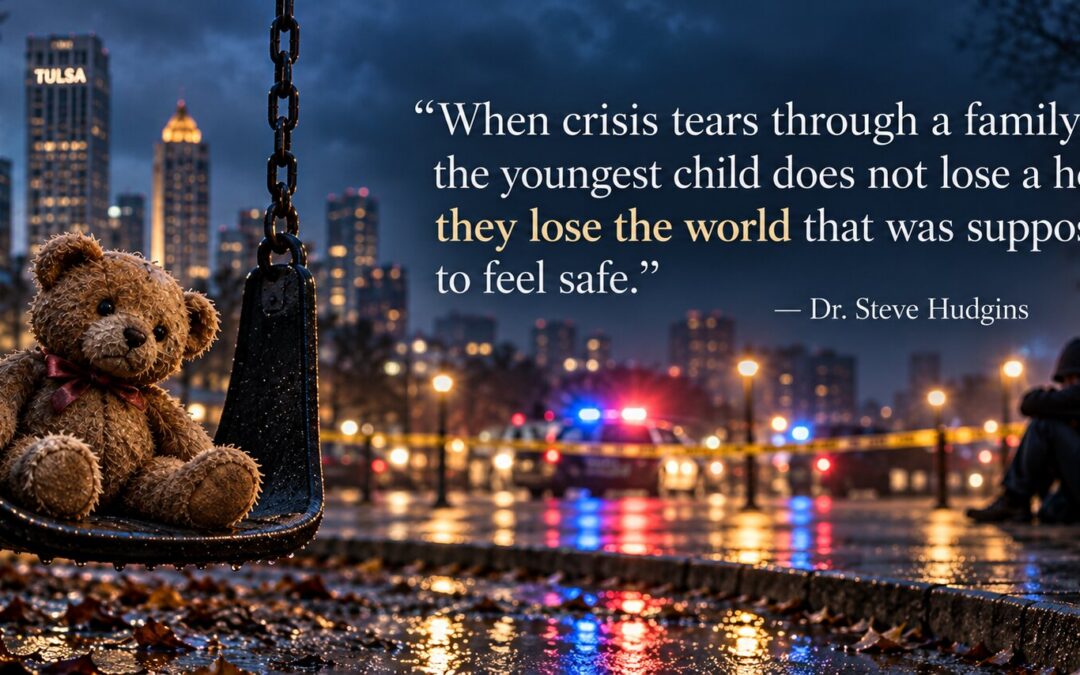
A troubling part of this story deserves attention precisely because so little attention seems to be given to it.
As of this writing, I have not been able to locate substantive local news coverage of the recent alleged DUI hit-and-run involving the death of an unhoused person (September 10-11, 2026). That absence concerns me; not because tragedy should be sensationalized, but because people who are homeless can too easily become invisible even in death.
A human being died.
A mother is reportedly incarcerated and may face a manslaughter charge.
Her two-year-old daughter reportedly lost her father only weeks earlier.
These are not simply separate incidents. They are intersecting parts of a family system in crisis, and somewhere at the center is a child too young to understand any of it.
That is the part we cannot afford to miss.
Young children do not experience mental-health crises, addiction, domestic conflict, incarceration, homelessness, or failures in community systems as separate categories.
They experience them as one thing: their world becoming unsafe.
I have been told that the child’s father had attempted to seek mental-health assistance before his death. That information deserves independent verification. Even if it is accurate, then an uncomfortable question must be asked:
What happened when he reached for help?
Was there simply an assessment, or was there meaningful connection to continuing care? Was there follow-up? Was the family system considered? Was the escalating crisis recognized in the context of a young child living within it?
We cannot responsibly say that a different intervention would have prevented his death. Human behavior is too complicated to be certain.
Regardless, we can ask whether we exhausted every reasonable opportunity for connection. That is what systems thinking demands. Sadly, another person has reportedly died; a person repeatedly described only by circumstance: homeless.
We should resist allowing that word to become the person’s identity.
Homelessness describes where someone was living.
It does not describe the value of the life that was lost. The same principle applies to this child. She should not become merely the forgotten child behind an arrest, a death, or tomorrow’s next headline.
The question for Tulsa should be larger than, “Who committed the crime?”
It should also be:
How do we identify families moving toward catastrophe before their youngest members inherit the consequences?
Mental health cannot operate in one silo, addiction services in another, law enforcement in another, homelessness services somewhere else, and child welfare only after everything has collapsed.
Families do not fracture in departments.
Families are mosaics. They are formed from pieces that have been shaped, fractured, repaired, and held together by something stronger than any single shard. The mortar is not perfection; it is connection, responsibility, support, and the willingness of people and systems to protect what is fragile before it breaks beyond repair.
The systems surrounding families should not simply react after the mosaic has shattered. They should help preserve its integrity while there is still time to intervene. That requires more than additional laws. It requires meaningful accountability, coordinated care, professional responsibility, and a community willing to recognize when a family system is becoming dangerously unstable.
We do not protect families by forcing them to remain intact at any cost.
We protect them by strengthening the conditions that make safety, stability, healing, and healthy connection possible.
A mosaic survives not because its pieces are unbreakable, but because something strong enough exists between them to hold them together. Our responsibility is to make sure that support is there before the pieces fall.
Children experience the whole system.
Accountability still matters due process matters. Personal responsibility matters, but prevention matters too.
If a father was reaching for help, we should understand what happened to that request.
If an unhoused person lost their life, we should care enough to know who that person was.
Finally, if a two-year-old child has now lost the presence of both parents within approximately six weeks, we should be asking what we can learn before another child becomes the silent survivor of an adult crisis.
Sometimes the person most profoundly affected by tragedy is the one whose name never appears in the headline.
— Dr. Steve Hudgins, LPC-S, NCC
Sources:
News 6 — Tulsa Police investigating death after Tulsa break-in
https://www.newson6.com/tulsa-oklahoma-news/tulsa-police-investigating-death-after-tulsa-break-in
Public report regarding the alleged DUI hit-and-run