
Some moments in life look, from the outside, like accomplishments.
A speaking engagement.
A room full of people.
A microphone.
A university invitation.
A photograph afterward.
Yet, sometimes the meaning of the moment has very little to do with being seen.
Sometimes the deeper significance is that life has finally brought you to a place where something you once struggled through has become something you can give away.
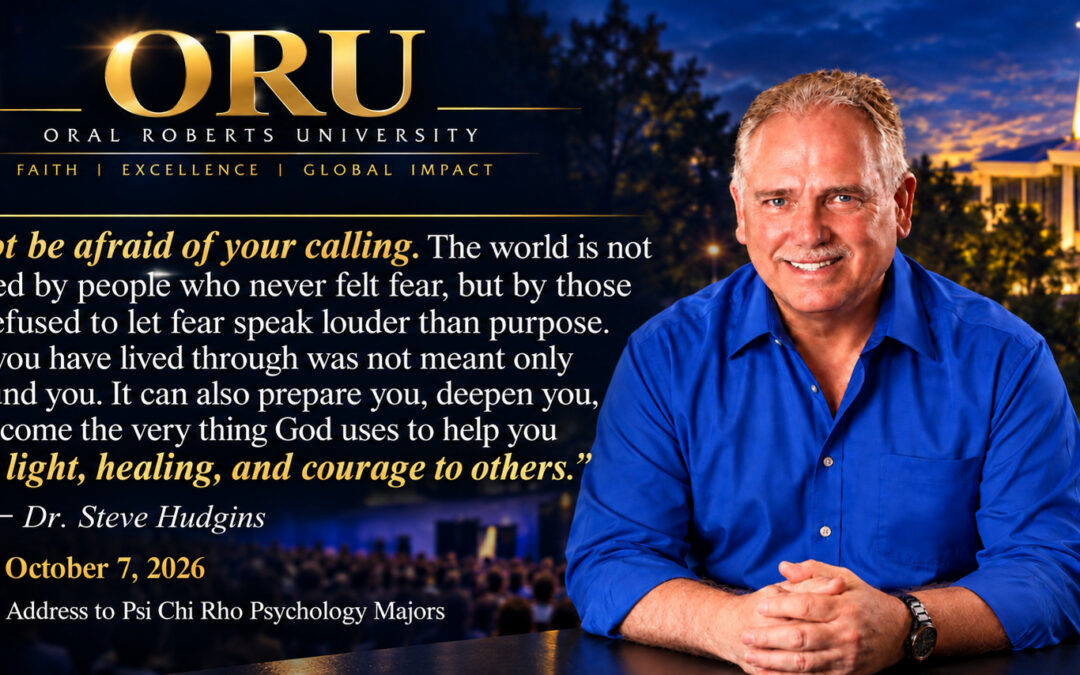
Recently, I was asked to address the Psi Chi Rho psychology majors at Oral Roberts University. I knew I did not want to simply talk about becoming a therapist.
Students can learn theories.
They can memorize diagnostic criteria. They can study interventions, ethics, human development, and the mechanics of counseling.
Those things matter, but becoming a therapist is not only an academic process.
It is also a human one.
Before we ever sit across from someone else’s pain, we are carrying our own history into the room. We bring our fears, unfinished questions, assumptions, wounds, strengths, faith, failures, and the conclusions we have formed about ourselves along the way.
That is why I wanted to talk about more than psychology.
I wanted to talk about identity.
The Journey Is Forming Someone
Most of us spend a great deal of life asking where we are going. We ask about careers, relationships, opportunities, accomplishments, and destinations. We want to know whether the road we are on is leading somewhere meaningful.
But beneath all those questions is another.
Who is this journey forming me into?
Perhaps the purpose of our journey is not merely to get us somewhere.
Perhaps it is to shape us into someone who can make a difference when we arrive.
Life has a way of educating us outside the classroom.
Loss can teach us something about presence.
Failure can teach us humility.
Rejection can reveal how much of our identity was built around approval.
Trauma can show us how deeply the nervous system remembers what the mind would prefer to forget.
Grief can teach us that some things are not repaired by explanation.
Healing can teach us that strength is not always loud.
Sometimes strength looks like learning how to remain present without running from yourself.
If we allow it, life can deepen us, but t that does not happen automatically.
Pain does not always produce wisdom.
Sometimes pain produces more pain.
The difference often comes through meaning-making. We begin examining what happened to us, what we concluded because of it, and whether those conclusions still deserve authority over our lives.
That is where growth begins to become something more than survival.
The Harshest Critic May Already Live Within Us
We often talk about critics as though they are always outside us.
Sometimes they are.
People will always misunderstand your journey, question your motives, minimize your growth, or keep speaking to a version of you that no longer exists.
Outside criticism is often most powerful when it finds agreement inside us.
Someone questions whether we are capable, and a quieter voice within us says, Maybe they are right.
Someone dismisses our growth, and something inside us whispers, Perhaps I have not really changed.
Someone criticizes our calling, and our own insecurity joins the conversation.
That is when criticism becomes more than noise.
It becomes identity.
The inner critic can become remarkably sophisticated. It knows our history. It remembers our failures. It can quote every mistake with precision while conveniently forgetting every season of growth.
It can convince us that we are not ready.
Not qualified.
Not worthy.
Not enough.
Sometimes we spend years trying to prove the critic wrong when the deeper work is learning that the critic was never supposed to have that much authority in the first place.
Successful living is not the absence of doubt.
It is not reaching some psychological state in which fear never returns.
It is learning which voices deserve authority.
Calling Does Not Require the Absence of Fear
We often imagine calling as something accompanied by certainty. I am no longer sure that is true. Many meaningful things begin with uncertainty.
People enter marriages without knowing every chapter ahead.
Parents bring children into the world without guarantees.
Therapists sit with clients knowing that human beings are more complicated than any treatment manual.
Leaders make decisions without possessing perfect information.
Writers release words they can no longer control once someone else reads them.
Calling often asks us to move before fear has disappeared.
That is why I have come to frame it this way:
“Do not be afraid of your calling. The world is not changed by people who never felt fear, but by those who refused to let fear speak louder than purpose. What you have lived through was not meant only to wound you. It can also prepare you, deepen you, and become the very thing God uses to help you bring light, healing, and courage to others.” – Dr. Steve Hudgins
That does not mean every painful experience was somehow necessary.
It does not mean suffering should be romanticized.
It certainly does not mean that terrible things become acceptable because something meaningful eventually emerged from them.
Meaning does not justify the wound.
But meaning can keep the wound from having the final word.
There is a difference.
When Experience Becomes Something We Can Give Away
One of the most powerful transformations in human life occurs when experience becomes service.
- Something happened to us.
- We struggled to understand it.
- We survived it.
- We wrestled with what it meant.
- Eventually, we found language for it.
- And one day, someone sits across from us experiencing something similar.
- Suddenly our past is no longer only memory.
- It has become recognition.
- We know something about the terrain.
We may not know their exact experience, and we should never assume that we do. But we understand enough about pain to remain present when someone else’s story becomes difficult.
That is one difference between simply knowing psychology and understanding people.
Textbooks can teach us what trauma is.
Human experience teaches us what it feels like when someone cannot find words for what happened.
Theory can teach attachment.
Life can teach us what it feels like to reach for connection while simultaneously fearing it.
Research can teach grief models.
Loss teaches us that grief rarely behaves as neatly as the diagrams suggest.
Both kinds of knowledge matter.
The most grounded helpers learn how to hold them together.
Impact Is Not the Same as Attention
The turnout at the presentation was meaningful to me.
Yet, the conversations afterward mattered more because impact is not ultimately measured by how many people are watching.
It is measured by whether something changes inside another human being.
Perhaps someone begins questioning a story they have been telling themselves for years.
Perhaps a future therapist realizes that personal growth is not separate from professional development.
Perhaps someone stops believing that their difficult history disqualifies them from meaningful work.
Perhaps someone begins to understand that healing does not erase their story. It changes their relationship with it.
Those moments are difficult to quantify, but they matter.
We live in a culture that frequently confuses visibility with significance.
They are not the same thing.
Some of the most important work we will ever do may never receive applause.
- A conversation.
- A moment of listening.
- A sentence spoken at the right time.
- A person who finally feels understood.
- A child who experiences safety.
- A couple who learns to speak differently.
- A client who begins to recognize themselves beneath years of shame.
- A student who discovers that becoming a therapist requires becoming more honest with themselves.
Those moments may never become public.
They can alter the direction of a life.
Pain Can Become Perspective
There is a sentence I keep returning to:
Our experiences are rarely meant to end with us.
Again, that does not mean everything that happens carries some predetermined lesson.
Sometimes terrible things are terrible.
However, we still have agency over what we build from what remains.
Pain can become perspective.
Struggle can become language.
Healing can become presence.
Failure can become humility.
Fear can become courage.
Our story can become a bridge between where someone is and where they are trying to go.
Perhaps that is one of the most meaningful forms of transformation.
Not becoming someone untouched by life.
Becoming someone deeply touched by life who has learned how to carry that experience without allowing it to destroy their capacity to love, serve, create, or hope.
A Different Question
For a long time, people have asked some version of the question:
Why did this happen to me?
It is an understandable question.
Sometimes it is even necessary.
But eventually another question may become more useful.
Who am I becoming because I went through it?
And then perhaps an even deeper one:
Whose life might be different because I dared to share what I learned?
That changes the meaning of calling.
Calling is no longer simply a career.
It is not a title.
It is not a platform.
It is not the size of the audience.
Calling becomes the place where who we are becoming intersects with something another human being needs.
Perhaps that is why we should not be afraid of it.
The calling may not be asking us to become somebody extraordinary.
It may simply be asking us to stop hiding what life has already been forming within us.
The journey doesn’t just take us somewhere. Sometimes it turns us into someone who can help another person find their way.