

“I have spent my life studying how things break, and how they heal. Whether in systems, families, or the soul, I believe brokenness is not the end. With grace, structure, and intention, we can rebuild something sacred.”
From Blended to Mosaic: Reframing the Modern Family
By Dr. Steve Hudgins, LPCS, NCC
Mosaic Family Systems Theory (MFST) is a trauma-informed, attachment-aware systemic framework developed to understand emotionally layered families formed through divorce, remarriage, relational fracture, and reorganized belonging.
We often hear the phrase “blended family.” It sounds smooth, maybe even sweet—like ingredients mixed into a smoothie. But anyone who has lived inside a second marriage, raised stepchildren, or navigated loyalty conflicts knows the truth: it is rarely that simple.
Blending implies uniformity.
Mosaic families are fromed through intentional belonging.
It suggests that everyone gives up their edges and histories to become something new.
Real families, especially those formed through divorce and remarriage, do not blend. They collide. They carry grief, complexity, beautiful differences and scars. That is why I no longer use the term blended family. Instead, I invite you to see your story as something more honest, more artful, and more redemptive.
More Than a Metaphor
For years, families formed through divorce and remarriage have often been described through simplified language that unintentionally minimizes their emotional complexity. Terms such as “blended family” frequently imply that fractured histories naturally merge together over time if enough effort, love, or patience is applied.
Yet families living inside these systems often experience something very different.
They navigate divided loyalties, shifting roles, attachment disruptions, unresolved grief, parenting differences, emotional survival adaptations, and the ongoing tension between past fractures and present belonging.
“What appears externally as conflict is often rooted in deeper emotional systems attempting to reorganize after relational disruption.”
As both a therapist and researcher, I repeatedly encountered a problem: many existing family frameworks helped explain portions of these experiences, but few fully captured the emotionally layered realities unique to remarried and post-divorce family systems.
That realization ultimately led to the development of Mosaic Family Systems Theory (MFST), a trauma-informed, attachment-aware framework designed to better understand how fractured relational histories continue influencing identity, connection, belonging, and healing within mosaic families.
MFST does not view these families as failed versions of intact systems. It recognizes them as distinct emotional ecosystems shaped by fracture, adaptation, resilience, grief, and intentional rebuilding.
Why Existing Models Fall Short
Unlike traditional intact family systems, mosaic families are not built from a single emotional lineage developing together over time. They are formed through the merging of multiple relational histories, attachment systems, parenting cultures, grief experiences, and emotional expectations into one shared environment. The family structure itself becomes emotionally layered.
Within a mosaic family, biological parents, stepparents, stepchildren, half-siblings, former spouses, extended families, and prior relational loyalties often continue influencing the emotional system simultaneously. As a result, the family does not operate from one unified emotional narrative, but from multiple intersecting narratives attempting to coexist together.
For example, one child may still be grieving the loss of the original family structure while another family member is excited about the formation of the new family. A stepparent may be attempting to establish connection while simultaneously navigating uncertainty regarding authority, acceptance, or emotional belonging. A biological parent may still carry unresolved pain from a previous marriage while attempting to emotionally invest in a new one. These emotional layers frequently exist at the same time within the same household.
This creates relational complexity that traditional family models were not originally designed to address. The emotional tension within mosaic families is often not simply about present conflict. It is about multiple unresolved emotional worlds attempting to reorganize themselves into a new shared system.
Mosaic Family Systems Theory recognizes that these overlapping emotional layers influence attachment, communication, discipline, trust, identity formation, emotional safety, and relational stability. What appears externally as conflict or dysfunction is often the manifestation of competing emotional narratives existing beneath the surface of the family system.
MFST, therefore approaches healing not through forced emotional uniformity, but through intentional understanding of the layered emotional realities each individual piece brings into the mosaic. Healing occurs when the system learns how to create belonging without demanding emotional erasure.
What Makes MFST Different?
Traditional family frameworks often assume continuity, unified attachment histories, and shared emotional development over time. Mosaic Family Systems Theory begins from a different assumption: many families are formed after relational fracture, emotional disruption, divided loyalties, and reorganized belonging.
Rather than viewing conflict only as dysfunction, MFST interprets many relational struggles as adaptive responses occurring within emotionally layered systems attempting to rebuild safety, attachment, identity, and connection after fracture.
MFST therefore focuses not simply on family structure, but on the emotional layering, survival adaptations, attachment disruptions, and intentional healing processes unique to mosaic family systems.
Core Principles of Mosaic Family Systems Theory (MFST)
1. Individual Pieces Matter
Every individual enters the family carrying an emotional history.
Mosaic Family Systems Theory begins with the understanding that every individual enters the family system carrying an already formed emotional history. No person enters a mosaic family emotionally neutral. Each individual brings attachment patterns, grief experiences, relational expectations, coping strategies, fears, survival roles, values, wounds, and prior family narratives into the developing structure.
Within traditional intact family systems, emotional development often occurs together over time. In mosaic families, however, individuals frequently arrive with entirely different relational histories already shaping their understanding of love, trust, safety, discipline, belonging, and connection.
Children may carry grief from divorce, confusion regarding loyalty, fear of abandonment, or anxiety surrounding relational replacement. Adults may carry unresolved betrayal, previous marital trauma, parenting insecurities, financial stress, or emotional guardedness from prior relational experiences. These emotional histories do not disappear simply because a new family structure forms.
MFST recognizes that healthy family development begins when each individual piece is acknowledged rather than emotionally erased. Healing requires understanding the emotional story each person carries into the system.
2. Unity Does Not Require Erasure
Healthy belonging does not require emotional sameness.
Traditional family expectations often unintentionally pressure mosaic families toward premature emotional sameness. Family members may feel pressure to immediately bond, adopt identical traditions, share emotional closeness, or function as though prior family systems never existed.
MFST rejects the assumption that healthy unity requires emotional erasure.
Healthy mosaic families do not force individuals to abandon prior histories, relationships, traditions, or emotional experiences in order to belong. Instead, they create relational environments where individuality is respected while connection is intentionally developed over time.
A child maintaining love for a biological parent does not diminish the possibility of connection with a stepparent. Grief over the loss of a prior family structure does not automatically indicate rejection of the new family system. Emotional complexity is not necessarily resistance. Often, it is evidence that the individual is attempting to integrate multiple relational realities simultaneously.
Within MFST, belonging is strengthened not through forced sameness, but through emotional safety, patience, flexibility, and the honoring of individual identity within the collective system.
3. Boundaries Function as Grout
Boundaries hold the system together without crushing individuality.
In a mosaic, grout is what holds individual pieces together without crushing or distorting them. Likewise, boundaries within mosaic families function as the relational structures that provide clarity, safety, stability, and emotional organization.
MFST views healthy boundaries not as emotional walls, but as protective relational frameworks that preserve both individuality and connection.
Mosaic families often experience increased role ambiguity due to overlapping parental roles, shifting authority structures, divided households, coparenting tensions, and unclear relational expectations. Without healthy boundaries, confusion frequently develops regarding discipline, loyalty, emotional responsibility, privacy, authority, and relational access.
Healthy boundaries create emotional predictability within emotionally layered systems. They clarify expectations while reducing anxiety, triangulation, resentment, emotional overreach, and relational instability.
Within MFST, boundaries serve as stabilizing structures that allow connection to occur without emotional collapse, identity loss, or systemic chaos.
4. Fracture Influences the System
Relational fractures continue shaping the emotional system long after legal transitions end.
MFST recognizes that relational fractures continue influencing the emotional system long after legal transitions have ended. Divorce papers may finalize a legal separation, yet emotional fractures frequently remain active within the family system for years.
Experiences such as divorce, abandonment, betrayal, parental alienation, unresolved grief, emotional neglect, trauma, addiction, or chronic conflict continue shaping relational dynamics beneath the surface of daily interaction.
Children may develop hypervigilance regarding rejection or conflict. Adults may unconsciously protect themselves from future pain through emotional distancing, overcontrol, people-pleasing, withdrawal, or defensiveness. Family members often react not only to present circumstances, but to unresolved emotional experiences connected to prior fractures.
MFST understands that many relational struggles within mosaic families are not random dysfunctions. They are often adaptive emotional responses developed within previous systems of instability, grief, or attachment disruption.
Rather than minimizing fracture, MFST seeks to understand how unresolved emotional pain continues influencing attachment, identity, trust, communication, and relational safety throughout the evolving family system.
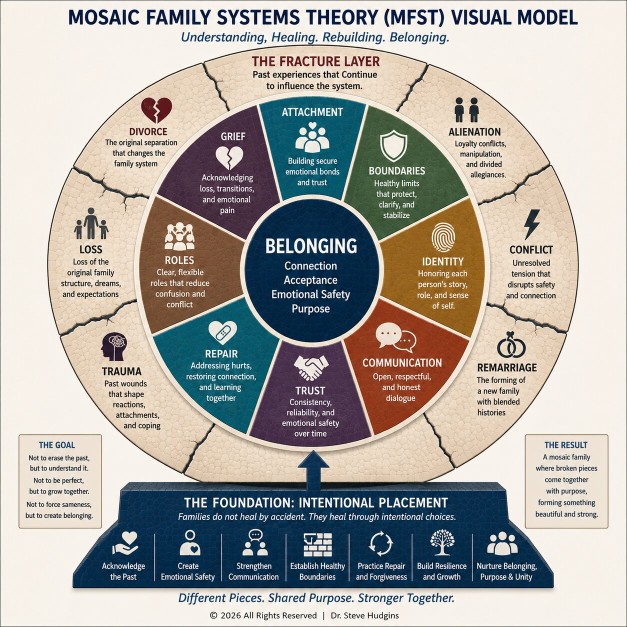
5. Healing Requires Intentional Placement
Healing occurs through intentional repair, emotional safety, and adaptive restructuring.
Mosaic families do not automatically heal through time alone. Shared housing, legal marriage, or physical proximity do not instantly produce emotional integration. Healing within mosaic systems requires intentional relational work.
MFST emphasizes that healthy family restructuring occurs through deliberate emotional placement. Just as an artist intentionally arranges broken pieces to form a meaningful mosaic, healthy families intentionally build emotional safety, communication patterns, trust, structure, boundaries, and belonging over time.
Healing often involves:
- acknowledging grief rather than suppressing it,
- developing attachment awareness,
- creating consistent relational safety,
- clarifying family roles and expectations,
- strengthening communication,
- rebuilding trust,
- practicing adaptive flexibility
- and learning how to repair emotional ruptures rather than avoiding them.
MFST views healing as an active process of relational reorganization. The goal is not perfection. The goal is the gradual development of resilience, stability, belonging, and emotional integration within a family system shaped by both fracture and hope.
Healthy mosaic families are not created because the fractures disappear. They are created because the family learns how to intentionally arrange the pieces with honesty, patience, grace, and adaptive connection.
The Research Foundation of Mosaic Family Systems Theory
Mosaic Family Systems Theory (MFST) emerged from Dr. Steve Hudgins’ doctoral research exploring divorce and remarriage within blended family systems through a hermeneutical phenomenological framework. While examining the lived experiences of individuals navigating remarriage, relational fracture, family restructuring, and emotional adaptation, recurring systemic patterns consistently emerged across participant narratives.
Participants repeatedly described experiences involving fractured identity, divided loyalties, attachment disruption, emotional displacement, role ambiguity, unresolved grief, boundary instability, parental alienation dynamics, and the ongoing struggle to establish belonging within newly formed family systems. These experiences often extended far beyond the legal realities of divorce or remarriage, continuing to influence emotional safety, communication patterns, relational trust, identity formation, and family cohesion long after structural transitions occurred.
The research further revealed that many participants felt unseen within traditional “blended family” frameworks. Existing language frequently minimized the emotional layering, attachment complexity, grief reconstruction, and relational fragmentation present within post-divorce family systems. Families were often expected to function according to assumptions designed for intact first-family structures despite carrying fundamentally different emotional histories and systemic realities.
As these themes consistently emerged throughout the research process, the need for a new conceptual framework became increasingly apparent. Mosaic Family Systems Theory was therefore developed to provide a more accurate systemic understanding of how fractured relational histories, overlapping emotional narratives, attachment patterns, survival adaptations, and intentional healing processes interact within remarried and emotionally layered family systems.
MFST conceptualizes the family not as a structure requiring uniformity, but as a mosaic composed of distinct pieces shaped by history, grief, resilience, attachment, identity, and relational repair. Rather than attempting to erase fracture, the framework seeks to understand how healing, stability, and belonging can emerge through intentional connection, adaptive boundaries, emotional safety, and systemic understanding.
The theory ultimately reframes many mosaic family struggles not as evidence of inevitable dysfunction, but as understandable relational responses occurring within emotionally layered systems attempting to reorganize belonging after fracture.
Clinical Application
What makes MFST powerful is that it does not merely describe family conflict. It reframes what conflict often means inside emotionally fractured systems. Traditional approaches frequently interpret resistance, emotional shutdown, loyalty tension, or instability as isolated dysfunctions requiring correction. MFST instead asks a deeper systemic question:
“What survival adaptation is this behavior protecting?”
That shift changes the entire therapeutic posture.
Many mosaic families are not simply struggling with communication problems. They are attempting to reorganize identity, attachment, safety, and belonging after relational fracture. Once that is understood, interventions become more compassionate, strategic, and attachment-informed rather than merely behavioral.
Clinical Application of Mosaic Family Systems Theory (MFST)
Mosaic Family Systems Theory provides therapists, educators, churches, couples, and family systems professionals with a framework for understanding how relational fractures continue influencing emotional systems long after structural changes occur. Rather than viewing mosaic family tensions as evidence of failure alone, MFST interprets many relational struggles as adaptive responses to disrupted attachment, fractured belonging, unresolved grief, and overlapping emotional narratives.
MFST assists clinicians in identifying the deeper systemic dynamics often operating beneath surface conflict.
Loyalty Conflicts
Children within mosaic families frequently experience divided emotional allegiance between biological parents, stepparents, former family systems, and new relational expectations. What appears externally as resistance or rejection may actually reflect an internal fear of betraying another attachment relationship. MFST helps clinicians recognize that loyalty tension is often attachment-based rather than oppositional in nature.
Boundary Confusion
Mosaic families commonly experience role ambiguity regarding discipline, authority, privacy, emotional access, coparenting expectations, and relational responsibilities. Without clear boundaries, anxiety and conflict often increase. MFST conceptualizes boundaries as “grout,” the stabilizing relational structures that create emotional safety without crushing individuality.
Attachment Disruptions
Divorce, abandonment, inconsistent parenting, betrayal, parental alienation, and repeated relational transitions frequently disrupt attachment security within mosaic systems. Children and adults may develop hypervigilance, emotional withdrawal, people-pleasing patterns, overcontrol, or defensive relational behaviors as protective adaptations. MFST allows therapists to interpret these responses through an attachment-informed lens rather than reducing them to behavioral pathology alone.
Role Strain and Survival Roles
Individuals within mosaic families often unconsciously adopt survival-based relational roles such as the peacemaker, scapegoat, achiever, invisible child, caretaker, or emotional protector. These roles frequently emerge as adaptive responses to instability or emotional unpredictability within prior systems. MFST helps clinicians identify how these survival roles continue shaping identity, communication, conflict management, and relational functioning within the new family structure.
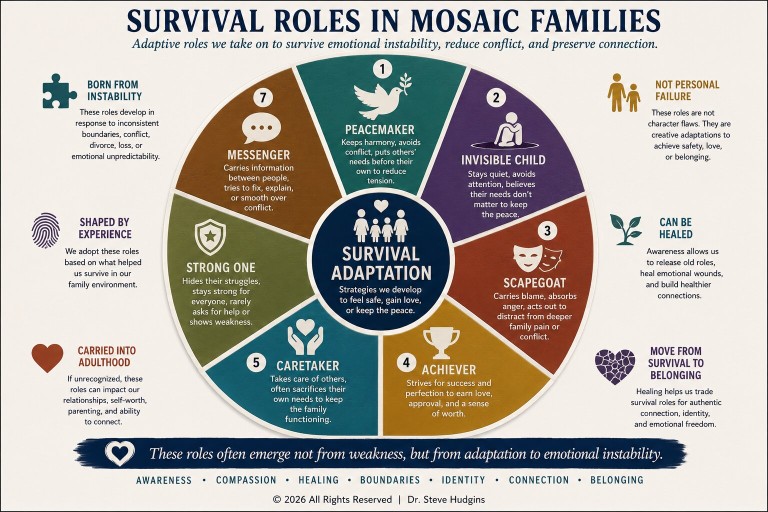
Survival Adaptations Within Mosaic Families
Identity Fragmentation
Many individuals entering mosaic systems struggle with fractured identity development. Children may question where they belong emotionally. Adults may wrestle with conflicting identities related to parenting, remarriage, coparenting, or prior relational wounds. MFST recognizes that family restructuring often disrupts not only relationships, but also internal identity organization.
Unresolved Grief
One of the most overlooked realities within mosaic families is unresolved grief. Family members may grieve the loss of the original family structure, former traditions, prior expectations, financial stability, emotional security, or imagined futures that no longer exist. MFST recognizes grief as an ongoing systemic influence rather than a temporary emotional phase.
Triangulation and Emotional Cutoff
Relational anxiety within mosaic systems frequently produces triangulation patterns where tension between two individuals is displaced onto a third person. Emotional cutoff may also occur when family members withdraw emotionally to reduce anxiety or avoid relational pain. MFST helps clinicians identify these systemic survival responses while working toward healthier emotional differentiation and direct relational repair.
Parental Alienation and Disruptive Attachment Dynamics
MFST provides a framework for understanding how parental alienation, narrative manipulation, emotional gatekeeping, and disrupted attachment bonds impact long-term family stability and identity formation. Children caught between competing emotional systems often experience chronic anxiety, confusion, emotional splitting, and attachment insecurity. MFST recognizes these patterns as profound disruptions to belonging and relational safety.
Beyond Dysfunction: Understanding Belonging After Fracture
A foundational distinction of MFST is that it does not interpret all conflict as evidence of pathology. Many tensions within mosaic families represent attempts by the emotional system to reorganize itself after rupture.
Resistance may reflect fear.
Withdrawal may reflect unresolved grief.
Control may reflect anxiety.
People-pleasing may reflect attachment insecurity.
Conflict may reflect competing survival narratives attempting to coexist within the same relational environment.
MFST therefore shifts the therapeutic goal from simply “stopping conflict” toward understanding how fractured emotional systems can rebuild safety, trust, identity, and belonging over time.
The theory recognizes that healthy mosaic families are not formed through forced emotional sameness. They are formed when emotionally layered individuals learn how to remain connected without abandoning their histories, identities, or emotional realities.
Application Across Systems
For Therapists
MFST provides clinicians with a trauma-informed, attachment-aware framework for assessing loyalty conflicts, role strain, emotional layering, and systemic fracture within remarried and post-divorce family systems.
For Churches and Faith Communities
MFST helps churches move beyond simplistic “blended family” assumptions by recognizing the grief, attachment wounds, identity struggles, and emotional complexities many families silently carry into faith communities. This framework encourages ministries built upon grace, patience, belonging, and intentional relational repair rather than pressure toward instant family integration.
For Educators and School Systems
Teachers, counselors, and administrators frequently encounter children navigating divided households, attachment stress, loyalty conflicts, behavioral adaptation, and emotional instability connected to family restructuring. MFST offers educators a framework for understanding how relational fracture impacts academic performance, emotional regulation, behavior, and identity development within educational environments.
For Couples and Families
MFST helps couples understand that many relational tensions within mosaic families are not signs of inevitable failure, but evidence of emotionally layered systems learning how to reorganize after disruption. The model encourages intentional communication, emotional safety, adaptive boundaries, patience, repair, and the honoring of each individual piece within the family mosaic.
Mosaic families do not heal because the fractures disappear. They heal because the system learns how to create belonging in the presence of those fractures.
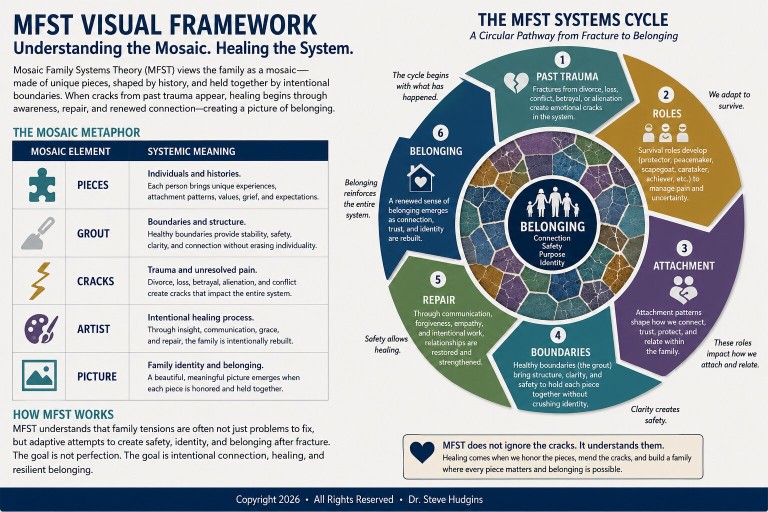
Mosaic Element Systemic Meaning
Who Mosaic Family Systems Theory Helps
Mosaic Family Systems Theory (MFST) was developed to help individuals, families, clinicians, educators, faith communities, and systems professionals better understand the emotional complexity that often emerges after relational fracture, divorce, remarriage, attachment disruption, and family restructuring. The framework recognizes that many individuals are attempting to rebuild belonging while simultaneously carrying unresolved grief, divided loyalties, disrupted attachment patterns, and survival adaptations shaped by prior relational experiences.
MFST provides language, structure, and clinical understanding for emotionally layered family systems that frequently feel misunderstood within traditional family models.
Remarried Couples and Mosaic Families
MFST helps remarried couples understand that many tensions within mosaic families are not signs of immediate failure, but evidence of multiple emotional systems attempting to reorganize after fracture. The framework assists couples in recognizing how attachment wounds, prior marital pain, parenting differences, grief narratives, and survival roles continue influencing the developing family structure.
Rather than forcing premature unity, MFST encourages intentional connection, adaptive boundaries, emotional safety, patience, and realistic expectations regarding the restructuring process.
Stepparents and Stepchildren
Stepparent relationships often carry unique emotional complexity involving belonging, loyalty tension, role ambiguity, trust development, discipline uncertainty, and attachment adaptation. MFST helps both stepparents and stepchildren understand that connection within mosaic systems frequently develops gradually rather than instantly.
The framework normalizes the emotional layering often present within these relationships while helping families create environments where individuality and belonging can coexist together.
Children Navigating Divorce and Family Transition
Children within mosaic systems frequently experience emotional displacement, divided loyalty, grief, fear of abandonment, identity confusion, attachment disruption, and anxiety surrounding relational change. MFST provides parents, educators, counselors, and caregivers with a deeper understanding of how children process family fracture internally.
The model recognizes that many behavioral responses within children are connected not simply to defiance, but to unresolved attachment needs, emotional insecurity, and the struggle to understand where they belong within changing family systems.
Therapists and Counselors
MFST offers mental health professionals a trauma-informed, attachment-aware systems framework for working with remarried couples, post-divorce family systems, loyalty conflicts, role strain, parental alienation dynamics, emotional cutoff, triangulation, grief reconstruction, and identity fragmentation.
The model assists clinicians in understanding how survival adaptations formed within prior relational systems continue influencing present family functioning. Rather than reducing symptoms to isolated pathology, MFST interprets many relational struggles as adaptive responses occurring within emotionally layered systems.
Churches and Pastoral Care
Faith communities often encounter mosaic families carrying invisible grief, shame, attachment wounds, relational exhaustion, and emotional fragmentation beneath the surface of outward family life. MFST helps pastors, ministry leaders, and church communities move beyond simplistic assumptions surrounding remarriage and blended family integration.
The framework encourages ministries rooted in patience, grace, emotional safety, belonging, and intentional relational restoration rather than unrealistic expectations of immediate emotional unity.
Family Courts, Mediators, and Coparenting Systems
MFST provides insight into how unresolved relational fractures, loyalty conflicts, parental alienation dynamics, emotional triangulation, attachment disruption, and chronic coparenting conflict influence both children and family stability over time.
The model helps professionals recognize that high-conflict family systems often involve deeper attachment injuries and survival responses beneath surface legal disputes. Understanding these emotional dynamics can improve communication strategies, conflict de-escalation, coparenting interventions, and child-centered decision-making processes.
Veterans and Trauma-Impacted Families
Military families, veterans, and trauma-impacted systems frequently carry unique emotional layers related to deployment, hypervigilance, emotional suppression, survival adaptation, loss, role shifts, and relational disconnection. MFST recognizes how trauma can continue shaping attachment, communication, trust, emotional safety, and belonging within family systems long after the initial experience has passed.
The framework helps families understand that emotional survival patterns developed in environments of instability or danger often continue influencing connection within the home.
A Framework for Emotionally Layered Systems
MFST was created for families and systems that traditional models often struggle to fully explain. It recognizes that mosaic families are not simply intact families with additional members added into the structure. They are emotionally layered systems shaped by fracture, adaptation, grief, resilience, and the ongoing human need for belonging.
The purpose of MFST is not simply to inspire families emotionally. Its purpose is to provide language, understanding, structure, and hope for individuals and systems attempting to rebuild connection after relational fracture.
Conclusion: Reframing Belonging After Fracture
Mosaic Family Systems Theory does not ask families to ignore the fractures that shaped them. It asks them to understand how those fractures continue influencing attachment, identity, emotional safety, communication, trust, and belonging long after relational transitions occur. Divorce may alter the legal structure of a family, but the emotional system continues carrying the imprint of grief, disruption, adaptation, and survival beneath the surface of daily life.
MFST recognizes that mosaic families are not failed versions of intact families. They are distinct emotional systems composed of layered histories, intersecting loyalties, attachment wounds, resilience, and evolving relational narratives attempting to reorganize connection after fracture. What many families experience is not evidence of inevitable dysfunction, but the complexity of rebuilding belonging within emotionally layered systems.
The theory therefore shifts the focus from forced sameness to intentional understanding. Healing does not emerge through emotional erasure, rigid expectations, or pretending the fractures never occurred. Healing emerges when individuals begin recognizing how their histories continue shaping the present system and when families intentionally create environments of emotional safety, adaptive boundaries, repair, honesty, grace, and relational patience.
Within a mosaic, broken pieces are not discarded because they carry cracks. They are intentionally placed into something meaningful. In the same way, MFST views individuals not as problems to remove, but as pieces carrying histories that still deserve understanding, dignity, and belonging.
The goal is not to erase the pieces. The goal is to understand how the pieces fit together.
Healthy mosaic families are not formed through forced uniformity. They are formed when broken histories learn how to remain connected without disappearing.
Some families are born through continuity. Mosaic families are forged through fracture, repair, and the courage to belong again.
The development of MFST reflects the intersection of clinical practice, doctoral research, lived experience, and systems-based understanding surrounding remarriage, attachment disruption, and reorganized belonging within emotionally layered family systems.
🧩 Participant Quotes to Support the Mosaic Vision
The Mosaic Shift
“It wasn’t easy learning to let go of the old picture of family. But slowly, piece by piece, a new image started to form, one I never expected, but one that felt like ours.”
Beyond the Brokenness
“It felt like I had been shattered, but I knew I couldn’t stay broken forever. I had to figure out how to rebuild—not just for me, but for my kids.”
Redefining Identity
“I felt like I had to hide parts of who I was to keep the peace, but over time, I realized those pieces made me who I am.”
Belonging Through Stories
“When we finally stopped trying to fit into predefined roles and started listening to each other’s stories, that’s when things shifted. Our differences became our strengths.”
Reclaiming Worth and Connection
“I went into my second marriage thinking it would fix what was broken in me. Instead, I had to fix myself first.”