
Some of the most important legislative conversations are not the ones where everyone begins in agreement. They are the ones where people are willing to stay at the table long enough to understand what the law must actually accomplish.
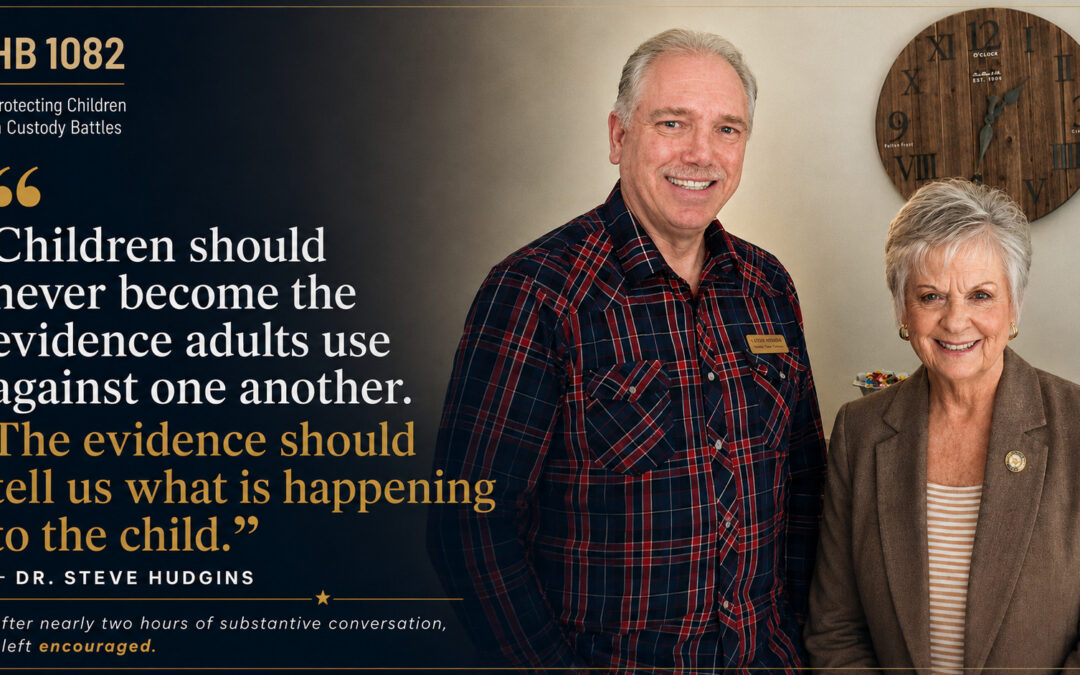
I had the privilege today of sitting down with Oklahoma Senate Majority Floor Leader Senator Julie Daniels for an extensive conversation about the revised HB 1082 and the future of child custody law in Oklahoma.
After nearly two hours of substantive conversation, I left encouraged. We did not spend that time simply discussing parenting percentages or competing parental rights. We discussed judicial discretion, evidence, unintended consequences, disrupted parent-child attachment, and ultimately the question that should remain at the center of every custody proceeding: What is actually happening to the child?
What made this conversation significant was not an expectation that we would agree on every provision or every word. Senator Daniels asked the kinds of questions responsible legislation should be able to withstand:
- How much discretion should a judge retain?
- What evidence should a court rely upon?
- How do we avoid unintended consequences?
- How will these changes actually function in an already complicated family-court system?
Those questions matter, and they brought us to what I believe is the heart of HB 1082.
This cannot simply be about fathers’ rights, mothers’ rights, or which parent receives more days on a calendar. It must be about protecting children.
The revised HB 1082 begins with the recognition that, when it is safe and healthy, children benefit from meaningful relationships with both parents. However, a presumption of substantially equal parenting cannot become an automatic outcome that ignores abuse, coercive control, neglect, fear, instability, poor parenting capacity, or other conditions that may be harming a child.
That is why the legislation must do something more difficult.
It must help courts distinguish allegation from evidence, conflict from danger, and parental accusation from measurable impact upon the child.
One of the most meaningful shifts in our discussion was moving beyond labels such as “parental alienation” and asking a more clinically and forensically responsible question: What is disrupting this child’s attachment to a parent, why is it occurring, and what effect is it having upon the child’s physical, mental, emotional, and moral well-being?
There can be many answers.
A child’s attachment can be disrupted by manipulation from one parent.
It can also be disrupted by domestic violence, coercive control, abuse, frightening behavior, chronic conflict, substance misuse, emotional instability, inadequate parenting, or the conduct of the parent from whom the child is withdrawing.
That is precisely why courts need more than competing narratives.
The goal of the revised HB 1082 is not to take thoughtful discretion away from judges. It is to give judges better information upon which to exercise that discretion: history, patterns, context, impact, corroborating evidence, and, when necessary, objective forensic evaluation by appropriately trained licensed mental-health professionals.
I believe today’s conversation represented a genuine breakthrough.
We were no longer merely discussing how parenting time should be divided.
We were discussing how Oklahoma can build a system that preserves important parent-child relationships while identifying, measuring, and responding to the circumstances that place children at risk.
I deeply appreciate Senator Daniels’ willingness to have a substantive conversation, to challenge assumptions, and to examine what these words will mean when they leave the Capitol and enter an actual courtroom and an actual child’s life.
Good legislation should survive difficult questions.
Children deserve nothing less.
A custody case should never be decided by which parent tells the more persuasive story.
The question must ultimately become: What does the evidence tell us is happening to this child?
#HB1082 #Oklahoma #FamilyLawReform #ChildWelfare #FamilyCourt #ChildCustody