
For too long, high-conflict custody conversations have centered on the battle between the parents.
- Who is alienating whom?
- Which parent is angry?
- Which parent appears more believable?
- Which parent is more cooperative?
However, somewhere in the middle of that conflict is a child whose developing attachment system may be absorbing every bit of it.
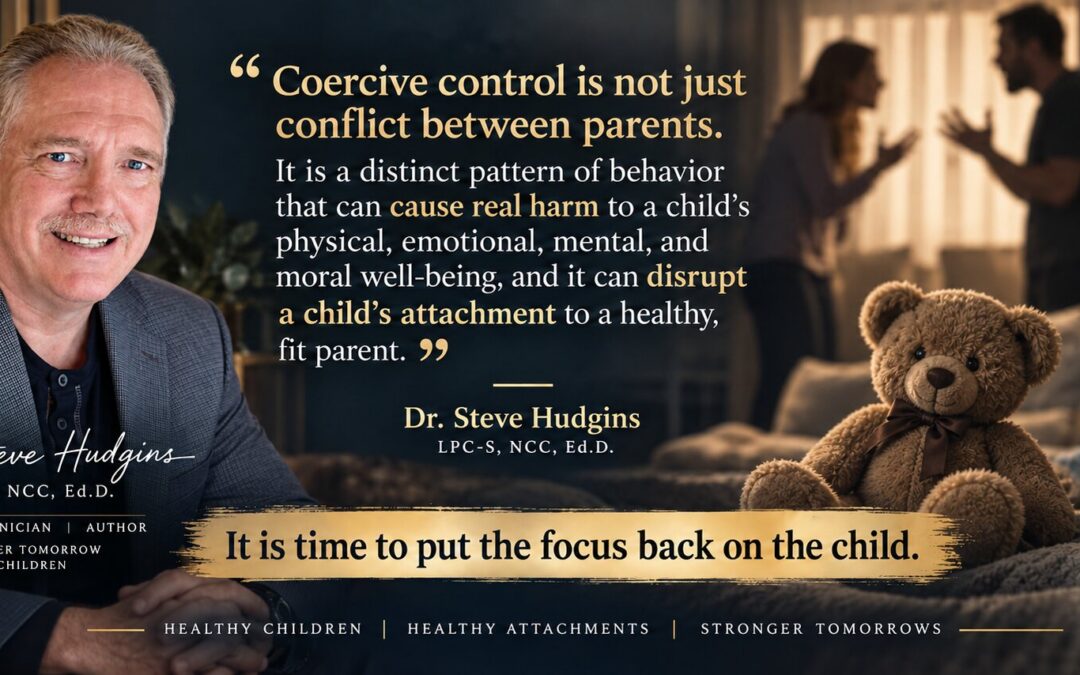
That is why one of the changes that I have written and am asking to be considered in Oklahoma HB 1082 is a clearer and more distinct recognition of coercive control as a pattern of behavior that can harm the physical, emotional, mental, and moral well-being of a child.
HB 1082 already recognizes coercive control within its domestic-violence language. We need to go further and understand the pattern itself and, most importantly, what that pattern can do to a child.
Coercive control is rarely one isolated incident.
It can become a relational system.
It can involve fear, intimidation, manipulation, monitoring, pressure, threats, financial control, interference with relationships, using access or affection as leverage, or repeatedly placing a child in circumstances where maintaining a relationship with one parent carries an emotional cost.
When those patterns begin interfering with a child’s relationship with a previously safe, healthy, and fit parent, my concern is no longer primarily about the rejected parent.
My concern is the child.
I describe that phenomenon as Disruption of Parental Attachment – DPA® (in my book Piece by Piece My Blended Experience of a Mosaic Family): the disruption of a child’s attachment to a previously safe parent through sustained relational pressures, manipulation, triangulation, coercion, or other dynamics, absent substantiated abuse or neglect that would reasonably explain the child’s withdrawal.
This is an important distinction.
Parental alienation language can easily cause the conversation to become centered on what has happened to the parent.
DPA® asks us to look at what is happening inside the child.
What happens when a child learns that loving one parent threatens the relationship with the other, affection becomes tied to loyalty, or the child feels responsible for an adult’s emotional well-being?
Over time, the issue is no longer simply custody.
It is attachment. Identity. Emotional security. Development. It also affects the child’s ability to maintain healthy relationships without believing that love requires choosing sides.
I have also spoken with Tulsa County District Attorney Steve Kunzweiler about the language courts use when making decisions that affect children. In those discussions, we have talked about moving beyond the traditional phrase “best interest of the child” and focusing more specifically on the child’s physical, emotional, mental, and moral well-being. He stands behind changing the law in Title 43.
That language matters to me because “best interest” can become an abstract legal conclusion.
Well-being asks us to examine the child and the patterns and behaviors can be measured.
Is this child emotionally safe, psychologically stable, free to love both healthy parents, and is this child’s attachment being protected?
It identifies the patterns and behaviors producing the harm rather than merely documenting the child’s reaction after the damage has occurred.
This is also why I am developing an assessment instrument intended to examine coercive control scientifically rather than simply creating another checklist for therapists, attorneys, or guardians ad litem.
The goal is to study whether we can reliably measure the pattern, severity, persistence, restriction of autonomy, psychological impact, and effect on relational functioning and attachment….because a court should not have to rely solely upon who appears calmer in the courtroom.
A therapist should not have to rely solely upon a checklist, and a child should not have to become symptomatic before adults begin asking what happened to their world.
I understand the pain of being the parent on the outside of a child’s life. I have lived parts of that story myself. Yet, this work cannot ultimately be about vindicating rejected parents.
It has to be about protecting children. The parent may experience the loss of the relationship.
The child experiences the disruption of attachment, and that is where I believe the conversation must begin. It is time for a change!