
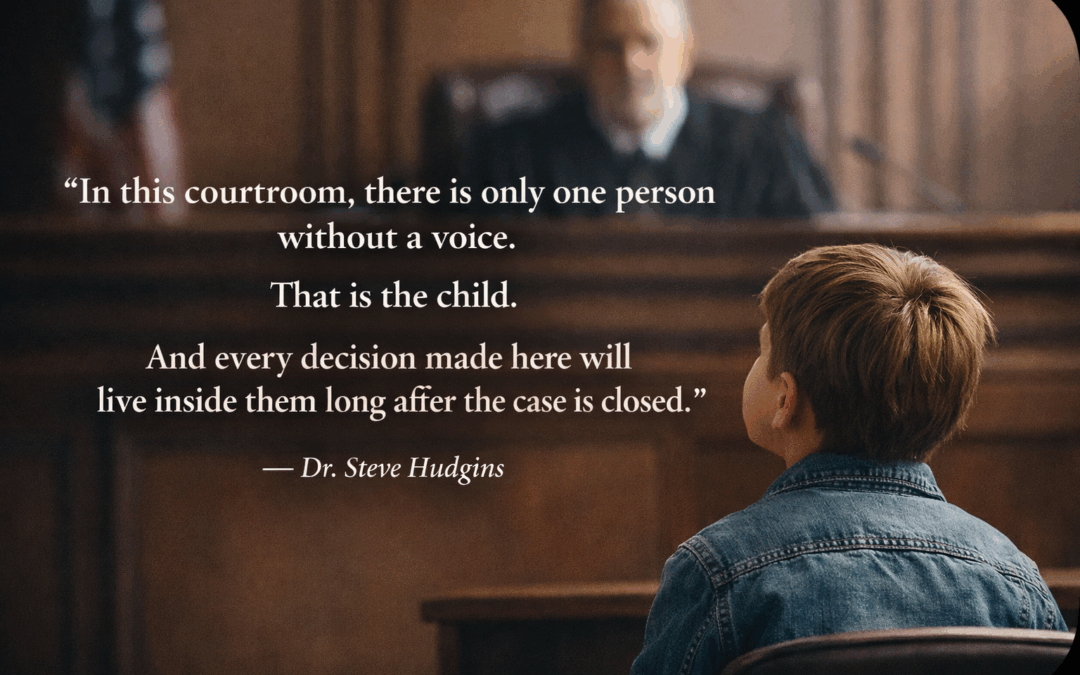
Family court was never meant to be a battlefield of competing adult narratives. Yet too often, custody disputes become prolonged conflicts where accusations, labels, and power struggles overshadow the child’s emotional, physical, and psychological welfare.
I was recently asked to serve as an expert witness in the Tulsa County Courthouse in a divorce case involving a minor child. The marriage itself lasted only three years, but the divorce dragged on for three additional years in the court process, with the child caught in the middle of a prolonged conflict.
What stood out to the representing attorney, and ultimately to the court, was that my testimony was not based on diagnosis, labels, or speculative syndromes. Instead, it focused on observable patterns of behavior and their measurable impact on the child.
That distinction matters.
Prolonged litigation, repeated behavioral disruptions, and failure to regulate conflict do not serve a child’s best interest. Courts must look beyond words and examine patterns, because patterns tell the truth that intent often hides.
The Problem with “Parental Alienation” Language
For years, family courts have struggled with the concept of parental alienation. The term itself often triggers defensiveness, polarization, and litigation battles over motive rather than the protection of the child.
Alienation language tends to ask:
- Who is the bad parent?
- Who is manipulating whom?
- Is this intentional?
Those questions rarely help a child.
What the court needs instead is a framework that asks:
- How is this child functioning?
- What behaviors are disrupting their emotional safety?
- Which environment allows this child to thrive?
A Shift Toward Child-Centered Evaluation
In this case, the attorney emphasized that the court’s focus should not rest on alienation claims or diagnostic labels. The issue before the court was not pathology, but patterns of conduct over time and the measurable impact those patterns had on the child’s emotional safety, regulation, and development.
That shift reframed the entire proceeding.
The court’s inquiry moved away from:
- Equal access
- Competing parental rights
- Lengthy accusations
And toward:
- Emotional welfare
- Physical safety
- Psychological stability
- The environment in which the child could genuinely thrive
Introducing Disruptive Parental Attachment (DPA)
The court considered the Disruptive Parental Attachment (DPA) framework, a behavior-based, child-impact model grounded in attachment research and outlined in my book, Piece by Piece: My Experience of a Mosaic Family.
DPA is not a diagnosis. It is not a syndrome. It does not presume intent.
It is a behavior-based, child-impact framework that evaluates whether a pattern of parental conduct interferes with a child’s secure attachment, emotional regulation, and psychological autonomy.
Rather than asking why a parent behaves a certain way, DPA asks:
- What is happening to the child as a result of these behaviors
When behavior disrupts attachment, the question is not who intended harm, but whether the child is being protected from it
What Courts Look for Under a DPA Lens
Courts applying this framework examine:
- Repeated boundary violations
- Narrative control that pressures a child emotionally
- Loyalty conflicts imposed on the child
- Anxiety around transitions
- Emotional dysregulation or withdrawal
- Fear of expressing affection toward the other parent
- Regression or stress-related behaviors
These are observable, documentable, and relevant to best-interest determinations.
Why This Matters Legally
From an evidentiary standpoint, DPA aligns with Rule 702 and Daubert standards because it relies on:
- Sufficient facts and data
- Reliable principles grounded in attachment science and child development
- Consistent application of the facts of the case
It avoids the pitfalls courts have repeatedly encountered with speculative or controversial constructs. This is why the framework proved useful to counsel and the court in clarifying the child-centered issues before them.
It Is Not About Equal Access
One of the most important clarifications made during testimony was this:
Custody decisions are not about equal access.
They are about equal protection of the child’s emotional, physical, and psychological well-being.
Equal time means nothing if the environment is emotionally unsafe.
Access without stability is not in a child’s best interest.
Fairness to adults cannot outweigh harm to a developing nervous system.
A Necessary Evolution in Family Court
The court ultimately considered Disruptive Parental Attachment because it clarified what truly mattered: the child’s ability to develop securely, regulate emotionally, and live without relational pressure or fear.
This is the direction family courts must continue to move.
Not toward louder accusations.
Not toward ideological labels.
But toward measurable child welfare, grounded in behavior, science, and the court’s fundamental duty to protect.
Final Thought
When we stop asking which parent is right and start asking how the child is doing, everything changes.
Protecting children requires more than equal access.
It requires recognizing when relational power is exercised in ways that compromise a child’s attachment, autonomy, and emotional safety.
That is where healing begins.
And that is where justice belongs.
The question before the court is never which parent deserves more time.
The question is whether the child will leave this courtroom safer than when they entered.
#ChildCenteredJustice #FamilyCourt #ChildWelfare #CustodyDecisions #AttachmentMatters #ParentalAlienation #BeyondAlienation #MentalHealth #ProtectChildren #BestInterestOfTheChild #ForensicPsychology #FamilyLaw #TraumaInformed #ExpertWitness #ChildCenteredJustice #ParentalAlienation #AttachmentMatters