
When the Law Measures the Child Instead of Judging the Parents
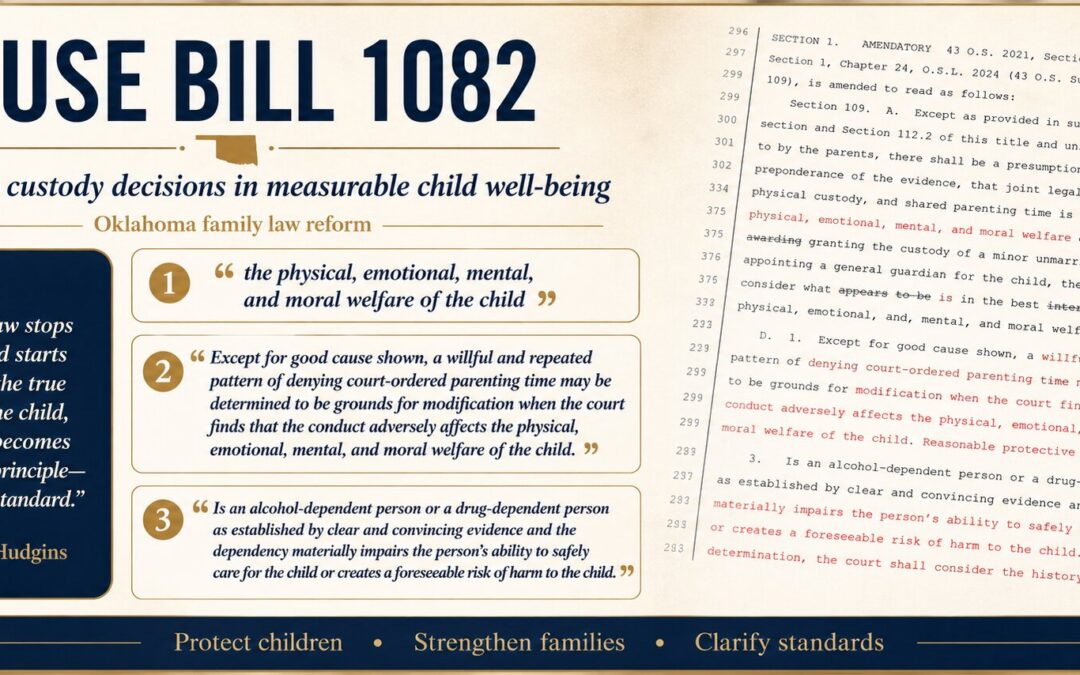
The image accompanying this post is not merely a graphic representation of House Bill 1082. It displays the actual statutory language under consideration. The language in black reflects the existing text. In contrast, the language in red represents recommendations I have proposed to make Oklahoma family law more informed by mental health, trauma, child development, and measurable child well-being.
For too long, custody disputes have been framed primarily as conflicts between adults. One parent accuses. The other parent defends. Attorneys construct competing narratives, and the court is asked to determine which parent appears more credible, more cooperative, or more aligned with an abstract legal standard.
Meanwhile, the child often becomes the evidence rather than the person the law was designed to protect.
One of the most problematic examples is the continued reliance on the language of parental alienation. The term directs attention toward what one parent is allegedly doing to another parent. It invites the court to identify an offender and a victim within the parental relationship. However, custody law should not exist to repair the emotional injuries of adults. Its first responsibility must be to understand what is happening in the child’s life, nervous system, development, relationships, and functioning.
That is why I have advocated for a more child-centered framework: Disruptive Parental Attachment.
In my book, Piece by Piece: My Blended Experience of a Mosaic Family, I discuss how children can become emotionally divided when parents remain at war. Sometimes the disruption is driven by unresolved anger, fear, control, coercion, untreated trauma, or personality-related patterns. At other times, a child may be reacting to actual abuse, intimidation, instability, or a credible fear of harm.
Those distinctions matter.
A child who withdraws from a parent should not automatically be assumed to have been manipulated. A parent who raises safety concerns should not automatically be accused of interfering with the other parent’s relationship. At the same time, persistent conduct that pressures a child to reject, fear, monitor, carry messages about, or emotionally care for one parent can create measurable psychological harm.
The law must examine the behavior, context, pattern, and impact.
This is why the proposed language repeatedly emphasizes the child’s physical, emotional, mental, and moral welfare. These are not decorative words. They create categories through which evidence can be evaluated.
Physical welfare may be examined through safety, supervision, medical care, physical injury, substance-related impairment, and exposure to violence.
Emotional welfare may be observed through anxiety, attachment disruption, emotional regulation, fear, guilt, loyalty conflicts, and the child’s sense of relational security.
Mental welfare may include cognitive functioning, concentration, trauma symptoms, depression, behavioral changes, school functioning, and the child’s ability to understand and navigate relationships.
Moral welfare may involve the values, boundaries, integrity, responsibility, and relational conduct being modeled around the child.
These areas can be evaluated through records, collateral information, behavioral observations, validated assessments, clinical interviews, school reports, medical documentation, and testimony from qualified professionals. The goal is not to diagnose every parent who enters a courtroom. The goal is to replace labels and assumptions with observable conduct and demonstrable impact.
In a recent matter in which I testified as an expert witness, a child presented with an Adverse Childhood Experiences score of seven out of ten. An ACE score is not, by itself, a diagnosis or a final custody determination. However, it can reveal the cumulative burden of adversity within a child’s developmental environment. A score that is elevated should cause every professional involved to pause and ask a more serious question:
What has this child been required to survive while the adults have been arguing about who is right?
The phrase “best interests of the child” has been used for generations, but it remains broad, subjective, and vulnerable to inconsistent interpretation. One judge may define it through parental cooperation. Another may emphasize stability. Another may focus on access to both parents, even when the quality or safety of that access has not been sufficiently examined.
A child should not be protected according to the preferences of the courtroom. A child should be protected according to evidence.
The proposed revisions to House Bill 1082 seek to move Oklahoma family law away from vague conclusions and toward a more factual inquiry. Has the conduct created fear? Has it impaired attachment? Has it disrupted emotional regulation? Has substance dependency materially affected caregiving? Has a parent repeatedly interfered with court-ordered parenting time? Were the parent’s actions unreasonable interference, or were they reasonable protective responses to danger?
These questions do not presume guilt. They demand examination.
Mental health language belongs in family law because custody decisions are ultimately developmental decisions. The court is not merely determining where a child will sleep. It is shaping the environment in which that child will learn what love, safety, authority, conflict, loyalty, and family are supposed to mean.
The law should not reward the parent who tells the most convincing story. It should identify the conditions under which the child can remain physically safe, emotionally secure, mentally supported, and relationally whole.
When we stop centering the conflict between parents and begin measuring the impact upon the child, custody law becomes more than a method of dividing time.
It becomes an instrument of protection.
The question is no longer which parent won the case. The question is whether the child was protected from having to lose themselves inside it. – Dr. Steve Hudgins