
One of the most painful moments in a family is not always the day the marriage ends.
Sometimes it is the moment a child realizes that the world they thought was permanent is about to change.
Parents often ask:
“How do I tell my children about the divorce without breaking them?”
There is no simple answer to that question, because children do not experience divorce through an adult lens.
A six-year-old and a sixteen-year-old may live in the same house, hear the same words, and still experience two completely different emotional realities.
A younger child may not understand betrayal, incompatibility, emotional disconnection, finances, legal decisions, or years of unresolved conflict.
They are thinking in much more immediate terms.
- Where am I going to sleep?
- Will Dad still pick me up?
- Will Mom still be there in the morning?
- Did I do something wrong?
- Can I fix this?
And perhaps the question they are too young to put into words:
Am I still safe?
An older child may understand more.
They may already know that something has been wrong. They may have heard arguments through the wall. They may have noticed the silence at dinner.
They may have watched one parent sleep in another room.
They may have learned how to read the emotional temperature of the house before they ever understood what marriage was supposed to feel like.
However, understanding more does not mean they should be asked to carry more.
This is where divorce becomes especially complicated.
Parents sometimes believe that because a teenager can understand the truth, they should hear all of it.
The affair.
The betrayal.
The money.
The texts.
The drinking.
The court filings.
The years of disappointment.
The evidence.
The reasons one parent believes the other is responsible.
Yet there is a difference between honesty and emotional burden.
A child can know the truth without becoming the container for an adult’s pain.
Age-appropriate honesty is not deception.
It is restraint.
It is understanding that children deserve truth, but they do not deserve to be recruited into the emotional war surrounding that truth.
Children should never have to become a witness for one parent against the other.
They should never have to become the messenger.
They should never have to carry information that changes how they are allowed to love.
They should never feel that comforting one parent means betraying the other.
They should never become responsible for managing an adult’s loneliness, rage, grief, or fear.
Perhaps most importantly, they should never believe that they are responsible for putting the family back together.
Children often personalize what adults assume they already understand.
A parent may say, “Mom and Dad are getting divorced.”
- But a child may hear:
- My family is disappearing.
- My home is disappearing.
- My routines are disappearing.
- Something happened that I could not stop.
- Maybe I was not good enough to keep everyone together.
- That is why what parents say in these moments matters so deeply.
A child may not remember every sentence.
They will often remember how the room felt.
They will remember whether they felt safe.
They will remember whether they were given permission to cry.
They will remember whether they were told they could still love both parents.
They will remember whether the adults remained adults.
And they will remember whether they were allowed to remain a child.
Sometimes the most important words are the simplest:
“This is an adult decision.”
“You did not cause this.”
“You cannot fix this.”
“You do not have to choose between us.”
“You are allowed to love both of us.”
“We will both still be your parents.”
“And whatever changes, you still belong.”
Divorce can change the architecture of a family.
It can change bedrooms.
Holidays.
Transportation.
Schedules.
Finances.
Traditions.
Schools.
Weekends.
Birthdays.
Even the meaning of the word “home.”
But there is something divorce should never be allowed to change:
A child’s belief that they still have a secure place in the hearts of the people who created their world.
Parents sometimes think children need to understand why the marriage ended.
Most children do not need the entire history of the marriage.
They need to know what happens to their life now.
Who will be there.
What will remain the same.
What will change.
And whether they are still loved in both places.
Children are remarkably capable of adapting to change when the adults around them provide emotional stability.
What wounds them most deeply is often not simply that the family changed.
It is being pulled into the conflict.
Being asked to choose.
Being used as a messenger.
Hearing one parent destroy the image of the other.
Feeling responsible for adult emotions.
Or becoming the battleground where unresolved marital pain continues long after the marriage has ended.
There is a profound difference between ending a marriage and making a child live inside the ending of that marriage every day.
One is a transition.
The other can become an emotional environment.
So before telling a child about divorce, perhaps every parent should ask one difficult question:
Am I giving my child information that helps them feel safe and understand what is happening… or am I giving them information because I need someone to understand what happened to me?
Those are not the same thing.
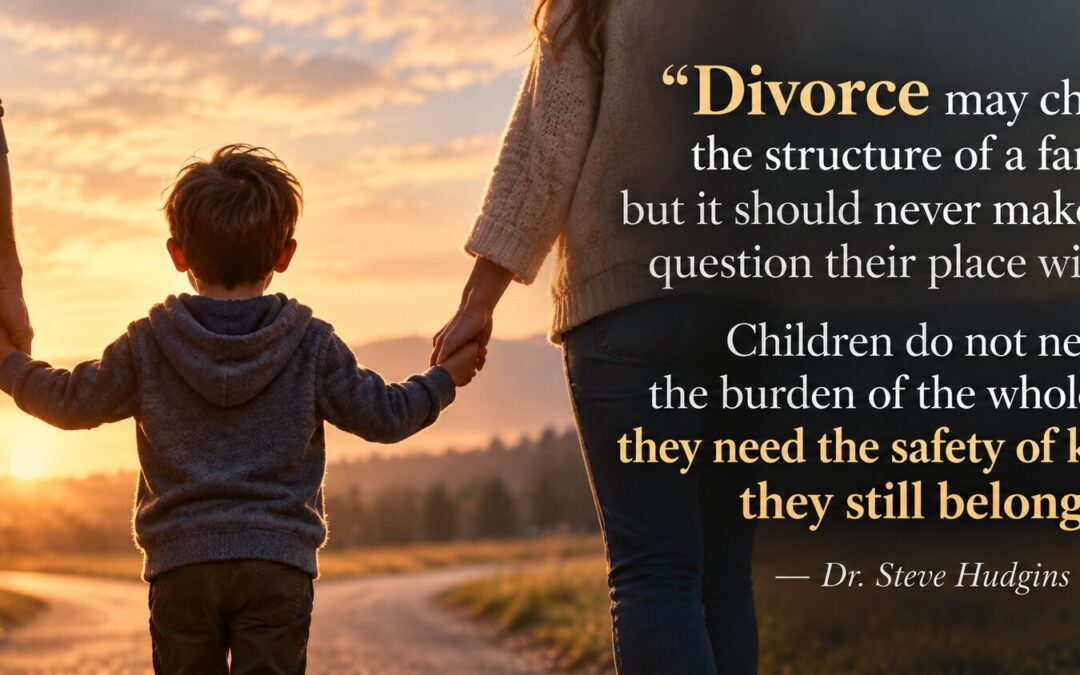
Children do not need the burden of the whole story.
They need the security of knowing that even when the family changes shape, they have not lost their place within it.
Divorce may change the structure of a family, but it should never make a child question whether they still belong. – Dr. Steve Hudgins