
How Men Learn to Carry Everyone While Disappearing From Themselves
The strongest man in the room may be the one no one has ever truly known.
People know what he provides. They know how quickly he solves problems, how much pressure he can absorb, and how reliably he appears when someone else is in crisis. They know the man who works, protects, pays, repairs, leads, and endures.
What they may not know is what frightens him.
They may not know what he grieves, what keeps him awake, what still makes him feel inadequate, or how often he wonders whether anyone would remain if he stopped being useful.
He has become visible through what he does while slowly disappearing from who he is.
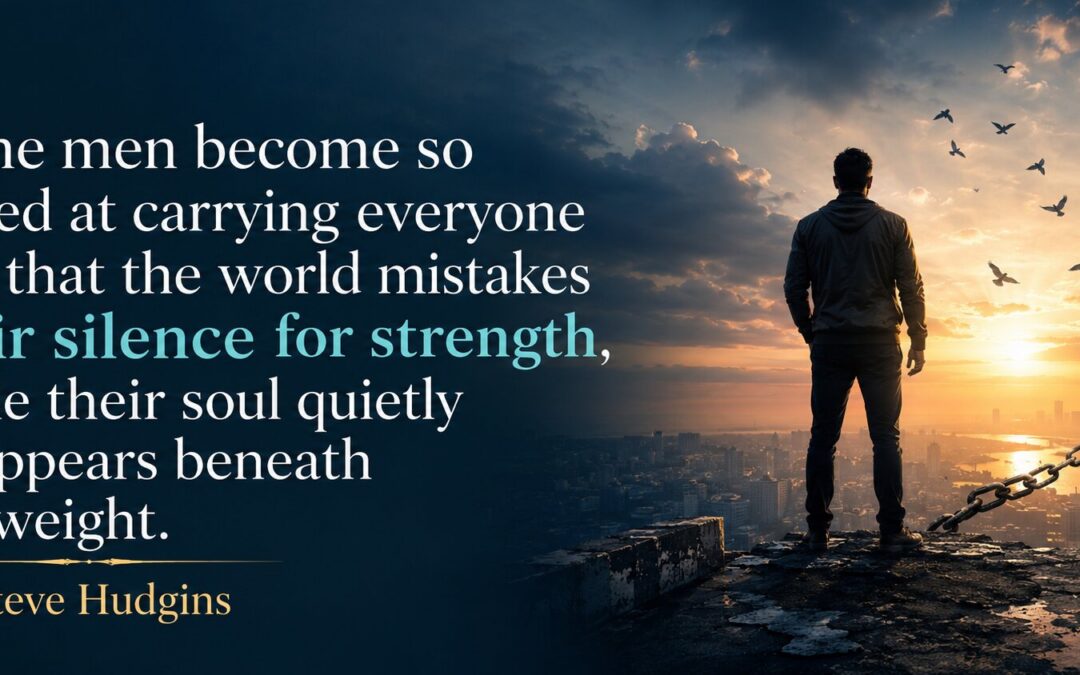
Some men become so skilled at carrying everyone else that the world mistakes their silence for strength, while their soul quietly disappears beneath the weight.
How Boys Learn to Disappear
Men are not born believing that vulnerability is dangerous. They learn it.
A boy cries and is told to toughen up. A teenager admits fear and is mocked. A young man reveals uncertainty and discovers that people become uncomfortable when he does not appear confident. A husband tries to explain that he feels overwhelmed, only to hear that others need him to remain strong.
So he adapts.
Fear becomes anger.
Grief becomes work.
Confusion becomes silence.
Love becomes provision.
Helplessness becomes control.
The boy learns that being needed is safer than being known.
These adaptations may help him succeed. He may become disciplined, responsible, self-sufficient, and dependable. Others may admire his composure without realizing that what looks like strength may also be emotional exile.
Competence is not the same as wholeness.
A man can become highly effective at managing life while remaining deeply disconnected from his inner world. He may know how to solve nearly every problem except the one occurring inside himself.
A man may master responsibility because responsibility never asks him to reveal who he is.
Strength is not the enemy. Families need men who are steady, courageous, dependable, and protective. The problem begins when strength becomes the only language a man is permitted to speak.
When that happens, strength stops being a capacity and becomes a hiding place.
When Love Becomes a Job Description
Many men learn to measure their worth through function.
They feel valuable when they are producing, fixing, rescuing, or protecting. They understand their place when someone needs something from them. The expectations are clear. There is a task to complete and a problem to solve.
Intimacy is different.
Intimacy does not always ask a man to act. Sometimes it asks him to remain present.
A wife may say, “I do not need you to fix this. I need you to listen.”
Yet listening may feel like failure because he cannot remove the pain. He may withdraw, offer solutions, become defensive, or shut down because helplessness awakens shame.
She experiences emotional absence.
He experiences inadequacy.
She believes he does not care.
He believes nothing he does is ever enough.
Both may be wounded as they interpret the same moment through different emotional histories.
The problem is not simply poor communication. Communication is often the visible symptom of a deeper belief: My value comes from what I do, not from who I am.
A man who believes love must be earned through usefulness may not know what to do when someone asks for his heart instead of his labor.
When the Family Organizes Around His Silence
A man’s silence never remains entirely his own. Families organize themselves around what can and cannot be spoken.
When a father rarely expresses emotion, children begin reading his moods instead of hearing his heart.
When a husband withdraws during conflict, his wife may pursue more intensely because emotional distance feels like abandonment.
The more she pursues, the more overwhelmed he becomes. The more overwhelmed he becomes, the farther he retreats. Soon they are fighting the pattern while believing they are fighting each other.
She says, “You never talk to me.”
He hears, “You are failing again.”
He says, “I need space.”
She hears, “You do not matter.”
Neither person may intend harm, yet both are reacting from older wounds.
Children notice these patterns even when no one explains them. One child may become the emotional bridge to the father. Another may become angry enough to express what everyone else avoids. A spouse may assume responsibility for the household’s emotional life while the man remains physically present yet increasingly unreachable.
A man can appear in every family photograph while slowly disappearing from the family story.
This is not about blaming men. Blame usually produces defensiveness, not transformation.
The deeper question is how a man became convinced that loving his family required him to carry everyone without ever allowing anyone to carry him.
The Anger Beneath the Silence
Anger is often the most visible emotion in men because it is sometimes the only emotion that received permission. Fear may have been called weakness. Sadness may have been ridiculed. Shame may have felt unbearable, but anger created distance, control, and protection.
An overwhelmed husband may not know how to say, “I feel inadequate, unseen, and afraid that I am losing you.”
Instead, he says, “Nothing I do is good enough.”
The anger is real, but it is rarely alone.
Beneath anger may be humiliation.
Beneath humiliation may be fear.
Beneath fear may be grief.
Beneath grief may be a longing to be accepted without having to perform.
Understanding this does not excuse intimidation, cruelty, control, or abuse. Harmful behavior must be confronted. Accountability remains necessary.
Yet understanding the deeper emotional structure helps explain why telling an angry man to calm down often changes very little.
The anger is not merely a volume problem. It is often a language problem. He has learned to shout what he was never taught to say.
The Armor That Followed Him Home
For veterans, first responders, medical professionals, and men raised in unstable homes, emotional containment may once have been necessary.
In dangerous environments, hypervigilance can preserve life.
Compartmentalization can help a person function. Emotional distance can make unbearable experiences survivable.
The difficulty begins when survival adaptations follow a man into spaces that require tenderness. The vigilance that kept him safe may make rest feel irresponsible. The command voice that created order in chaos may frighten the people he loves. The emotional distance that helped him function under pressure may leave his spouse feeling abandoned.
The armor was not foolish. It was formed for a reason. Armor designed for danger can become a barrier to intimacy.
The armor that helps a man survive one world may prevent him from being embraced in another.
Maturity does not require a man to reject strength. It requires him to recognize when strength should stand guard and when it should step aside.
When Faith Rewards the Mask
Faith communities can become places of healing, but they can also unintentionally reinforce a man’s disappearance.
Men may be told to lead, provide, protect, remain disciplined, and stand firm. These are meaningful virtues. Yet leadership without emotional honesty can become another mask.
A man may know how to pray publicly while being unable to confess privately. He may know how to defend doctrine while remaining afraid to admit that he is lonely. He may serve everyone in the church while becoming a stranger in his own home.
Scripture does not present strength as emotional numbness.
David grieved.
Jeremiah lamented.
Peter wept.
Jesus expressed sorrow, compassion, anguish, and distress.
Jesus did not become less powerful when He wept. His tears revealed that strength and tenderness were never enemies.
A spiritually mature man is not a man who feels nothing. He is a man whose feelings no longer have to hide from God.
Faith does not call men to become invulnerable. It calls them to become truthful.
The Courage to Be Known
There comes a moment when the strong man begins to realize that the life he built to protect everyone is also separating him from them.
His children go to someone else with their emotional concerns.
His wife stops asking what he feels because she no longer expects an answer.
He realizes he is respected by many people but deeply known by very few.
This realization may feel like failure. It is not failure. It is awakening.
The strongest moment in a man’s life may not be when he stands alone against the world. It may be when he admits that standing alone has become the problem.
Healing begins when a man stops measuring his value solely by what he can carry. It begins when he allows himself to grieve without apology, to admit fear without humiliation, to receive care without shame, and to remain present when he does not have an answer.
A healed man does not abandon strength. He stops using strength to abandon himself. The goal is not to make every man speak the same emotional language. Not every man will process aloud. Not every man will cry easily. Not every man will express vulnerability in the same way.
The goal is not performance.
The goal is presence.
A man becomes emotionally present when he can recognize what is happening within him and remain connected without retreating into silence, anger, work, control, or avoidance.
The strong man no one knows does not need to become weaker. He needs to become visible. He needs to understand that being loved requires more than being useful. It requires allowing another person to encounter the man beneath the role.
Perhaps the greatest act of courage is not carrying one more burden.
Perhaps it is allowing someone trustworthy to see the burden already there.
A man does not become weak when he allows himself to be known. He is freed from the belief that he must disappear to be loved.
The world does not need men who feel nothing.
It needs men strong enough to remain present when feeling something costs them their armor.